Maximum performance is the starting point. A lean Rust kernel, first-class thick and thin tasks, and an agent-native architecture designed to make every core count—and keep your machine responsive.
Early development · ARM64 first · Performance first
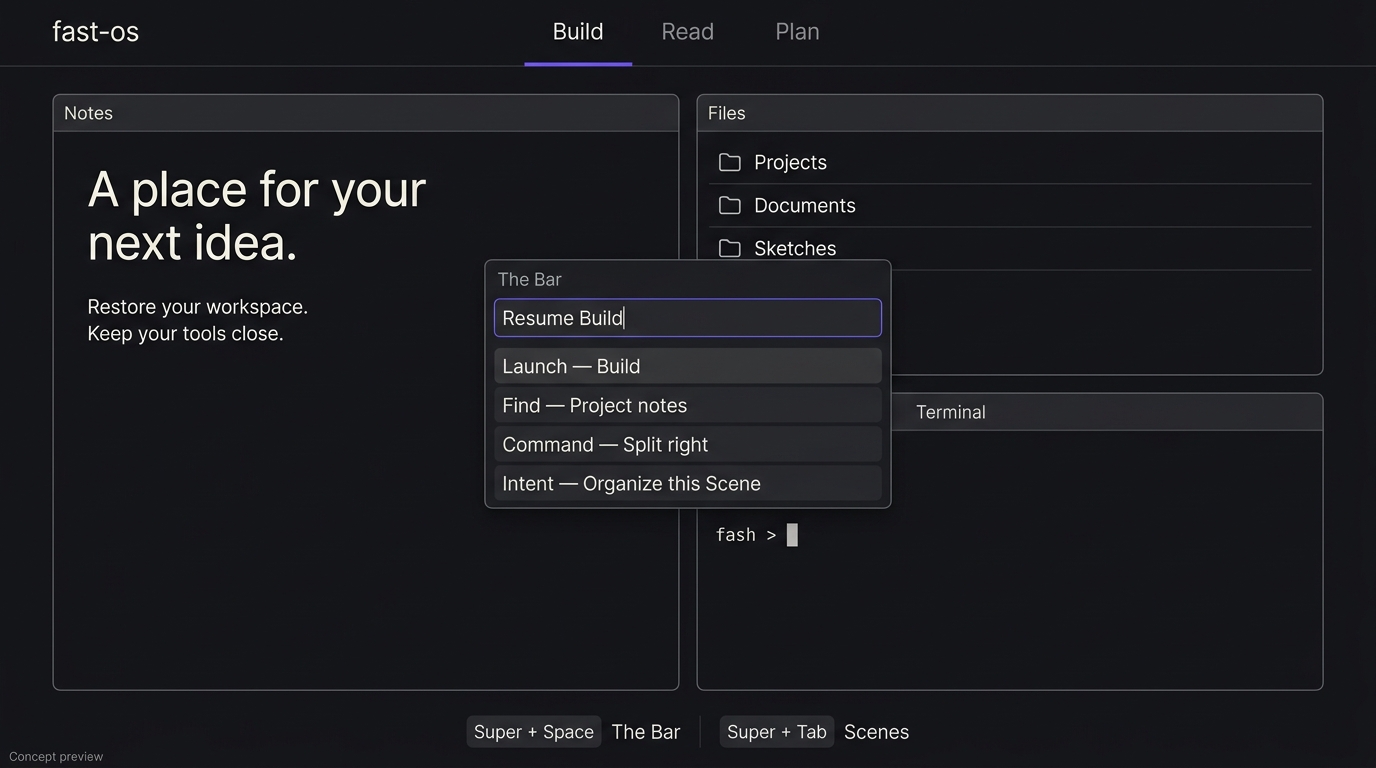
A workspace that remembers.
01 / SCENES + THE BAR
AI-generated concept preview. Scenes and The Bar are planned features; this is not a screenshot of the current build.
PERFORMANCE FROM THE CORETHICK + THIN TASKSOPTIMIZED RUST KERNELAGENT-NATIVE BY DESIGN
EVERY CORE. EVERY CYCLE.
Remember when a computer felt fast?
Inspired by the responsiveness that made BeOS memorable, fast-os puts performance at the center of the OS design. The ambition: instant-feeling interaction, sustained throughput, and a machine that stays responsive while serious work gets done.
01 / KERNEL
Optimize the foundation.
A from-scratch Rust framekernel keeps privileged machinery behind a small core boundary. A single-address-space design and asynchronous submission/completion rings aim to cut transitions, batch work, and reduce the overhead between an application and the hardware.
Frame foundation built · primary ring interface planned02 / CONCURRENCY
Thin tasks. Lots of small work.
Lightweight, message-passing tasks share a pool of cores. The design favors small footprints and cooperative progress, with timer-backed preemption to keep one busy task from taking over. A natural fit for agents, tools, watchers, and background work.
Dual-mode scheduler in development03 / COMPUTE
Thick tasks. Room to run.
Compute-heavy work can request a dedicated core lease. The target is fewer scheduling interruptions and predictable execution for inference, codecs, DSP, and other hot loops, while a protected shared pool keeps the rest of the machine moving.
Exclusive core leasing in development
Thick and thin threads, first-class in the OS.
One kernel task identity, two execution modes. The planned scheduler lets a task start thin, switch to thick for a compute burst, then return to the shared pool without restarting or losing its mailbox, permissions, or budget. Performance adapts to the work.
Performance is a design priority, not a published speed comparison. The full dual-mode scheduler is still in development; latency, scale, and throughput targets must pass milestone measurements.
THE IDEA
Give intelligence a better foundation.
Agents need tools, context, compute, and boundaries. fast-os is being designed to make those part of the operating system itself.
01
Less overhead. More possibility.
A Rust framekernel, asynchronous rings, and a dual-mode scheduler form the performance-first foundation. The aim is to maximize useful work per core while keeping interactive tasks responsive.
Foundation built · scheduler in progress02
Pick up where you left off.
The planned Scenes system restores apps, files, and layouts as one workspace. The Bar brings launching, finding, commands, and intent into a single keyboard-first surface.
Planned experience03
Powerful agents. Bounded authority.
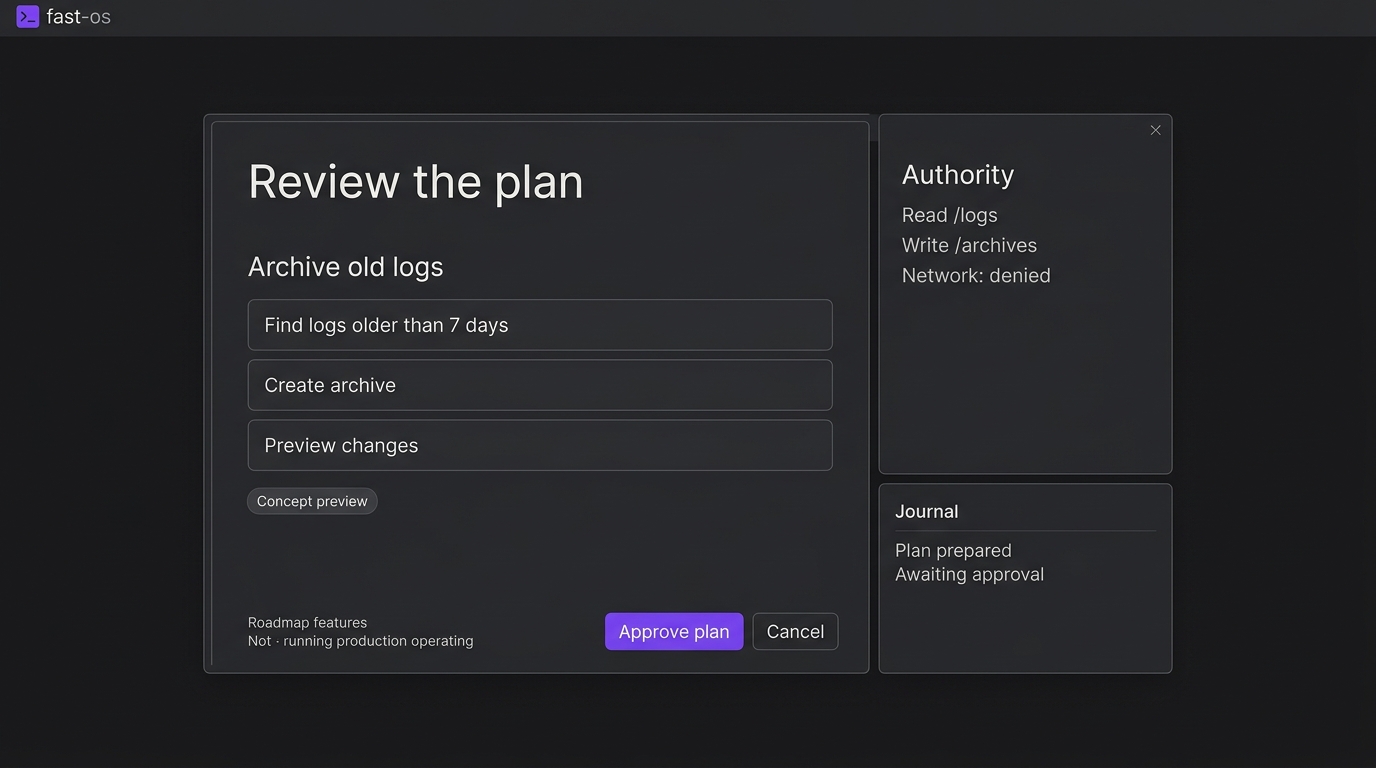
The vision: scoped permissions, explicit budgets, reviewable plans, and a journal of agent actions. Delegate a task while keeping its reach and effects visible.
Planned agent platform
INTENT, WITH CONTROL
See the plan. Set the boundaries.
Ask for an outcome. Review the tools and permissions it needs. The planned agent surface makes approval and an action journal part of the OS experience.
AI-generated concept · planned permissions and plan review.
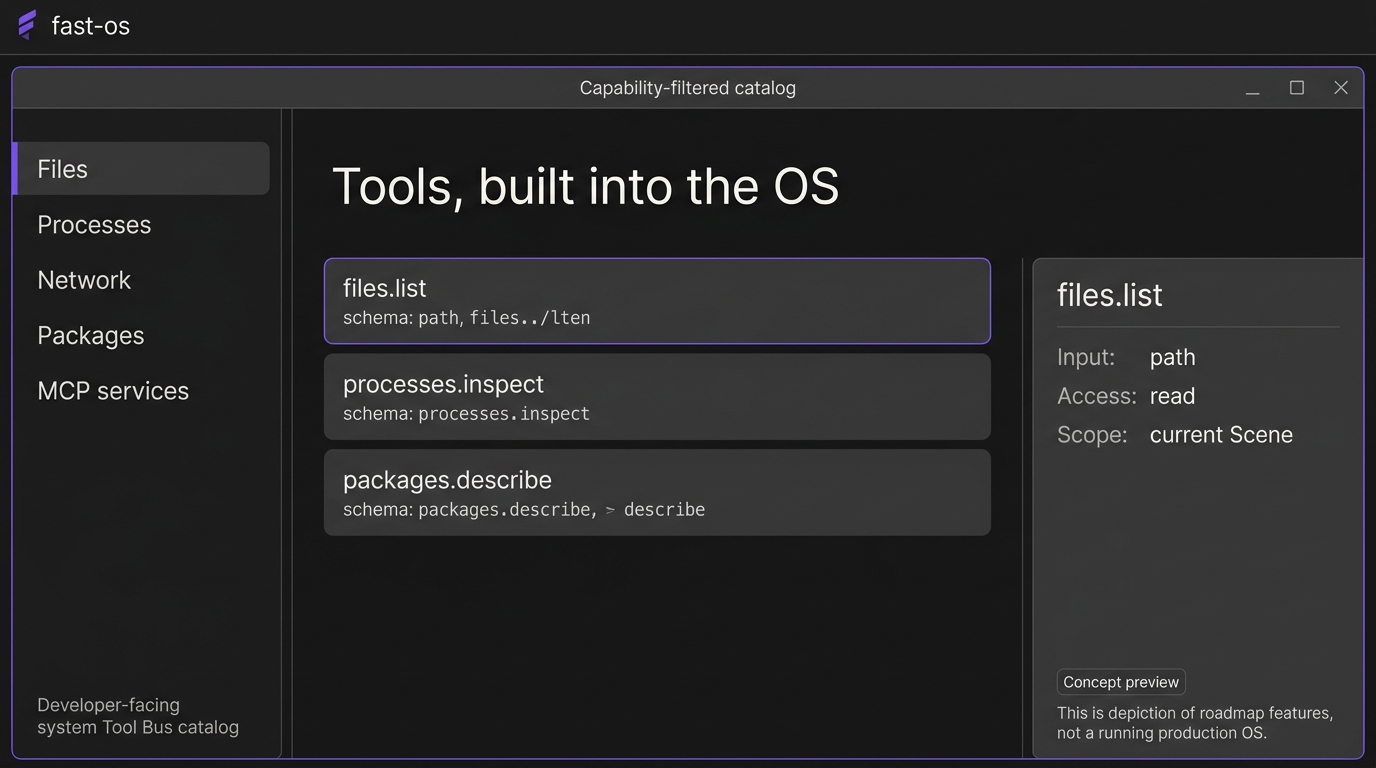
THE OS IS THE TOOL SERVER
Tools that belong to the system.
Files, processes, packages, and external MCP services, discoverable through one typed catalog. The roadmap treats MCP services as managed system services, with capability-scoped access.
AI-generated concept · Tool Bus and MCP services are planned.
REAL PROGRESS. A CLEAR ROADMAP.
A working foundation. An ambitious next chapter.
fast-os is an experimental OS for curious developers, systems builders, and people exploring how humans and agents should share a machine.
BUILT
Boot. Explore. Build.
ARM64 boot, the Rust frame foundation, a live UTM desktop, storage and installer paths. M0 and M1 are closed.
IN PROGRESS
The scheduling core.
M2 develops first-class thick and thin execution: lightweight concurrency, dedicated core leases, and switching modes as workloads change. Prototypes exist; the full milestone is still ahead.
ON THE ROADMAP
A native home for agents.
Capability enforcement, userland, managed MCP services, shared inference, semantic memory, and the agent experience.
Follow development or put your name down for future beta access. We’ll share progress and invite opportunities as the project matures.
Beta interest is not an immediate download or a guaranteed invitation. No release date is promised.
A FEW THINGS TO KNOW
Can I use fast-os today?
The current development image runs in UTM on Apple Silicon. The source repository is private, and access is not generally available yet. Register your interest in future beta access. fast-os remains an experimental system rather than a daily-driver replacement.
Are the agent features running already?
No. The screenshots illustrate the intended experience. Inference, semantic memory, the Tool Bus, Scenes, and the full agent shell are roadmap work. The roadmap above distinguishes the working foundation from planned capabilities.
Will it run my existing applications?
Linux compatibility through the planned Line layer, and later Proton packages, are roadmap goals. Existing Linux, Windows, or macOS application compatibility is not available or guaranteed today.
What happens when I sign up?
Choose development updates or beta access interest. Foryou handles your email and sends a confirmation link. Confirm to opt in; you can unsubscribe through the emails. Joining the beta list does not automatically subscribe you to general updates.